Introduction to Philosophy Pages






![Contents:
(1) Biographical Sketch
(2) “Estranged Labor” Vocabulary
(3) “Estranged Labor” Textual Review
(4) “Estranged Labor” Summary
(1) Biographical Sketch
Karl Marx (1818-1883)
Karl Marx was born in the western region Prussia (Rheinish Prussia) on May 5, 1818 into a Jewish home, although he converted to Protestantism in 1824. His father was a lawyer, which he began to study along with history and philosophy at university in Bonn and then Berlin. His thesis was on Epicurus’ philosophy [1 --see notes, below]. He was greatly influenced by Hegel, joining the “Left Hegelians,” who interpreted him as atheistic and revolutionary [2]. Marx gave up the pursuit of becoming a professor when he saw his compatriots rejected from and denied teaching positions for their political beliefs.
In 1842 Marx began writing for a radical paper in (the Rheinische Zeitung) Köln, Germany, shortly after becoming its editor until the government suppressed it in 1843. This inspired Marx’s intensive study of the political economy.
He married a childhood friend (a daughter of Prussian nobility) and left for Paris in the autumn of 1843 to reinitiate a radical paper/journal (Deutsch-Französische Jahrbücher), of which only one issue appeared; his writing therein is said to show that he was already a revolutionary who advocated “merciless criticism of everything existing” (marxist.org) and deeply appealed to the proletariats.
In 1843 Ludwig Feuerbach [3] (an influence all along) wrote his famous Principles of the Philosophy of the Future henceforth galvanizing the views we later call Marxist. The following year Frederick Engels visited Paris and became instant friends with Marx; shortly thereafter, the two co-write The German Ideology, which lays the foundations of Marxism and a materialist history (which meant a breaking from the Left Hegelian idealism). Marx wrote: “the philosophers [namely Bruno Bauer and Mac Stirner] have only interpreted the world in various ways; the point [however] is to change it” (outline for beginning of T.G.Ideology).
Marx and Engels were both active in the revolutionary groups of Paris. The Prussian government insisted that Paris expel them in 1845, which the French did, labeling them ‘dangerous revolutionaries.’ Marx moved to Brussels, Belgium. In 1847 he and Engels joined and became high-ranking members of the secret “propaganda society” the “Communist League” [4]; it was for this organization that they wrote the Communist Manifesto (Feb. 1848).
The Communist Manifesto (Feb. 1848) explains the world through the lens of materialism; it examines social life, class struggle, the tasks of communism, and the revolutionary role of the proletariat in order to form a new society based on equality.
That same month, Marx was banished from Belgium. He returned, briefly, to Paris (witnessing the March Revolution [5]). Then went back to Köln as editor-in-chief of the Neue Rheinische Zeitung, which survived nearly one year. First he was sued, then acquitted, and then banished from Germany on May 16, 1849. He went to Paris, then was banished, again, after a demonstration on June 13, 1849. He finally fled to London with his family until his death in 1883, initially living there under great hardship and poverty, supported only by Engels while he started writing Capital, perhaps his most important work.
His hardship was somewhat alleviated by the founding, in 1864, of the “International Workingmen’s Association” (IWA, aka First International) in London that was based upon the ideas of Marx but uniting the labor movements across the political and ideological spectrum. Throughout the 1870’s (despite setbacks like the fall of the Paris Commune [6] and a schism between Marx and Bakunin [7]), the labor movement grew and spread across the world.
Ill health prevented his completion of the last two volumes of Capitol (put together from notes by Engels after Marx’s death). He passed away on March 14, 1883.
“And now as to myself, no credit is due to me for discovering the existence of classes in modern society or the struggle between them. Long before me bourgeois historians had described the historical development of this class struggle and bourgeois economists, the economic anatomy of classes. What I did that was new was to prove: (1) that the existence of classes is only bound up with the particular, historical phases in the development of production (2) that the class struggle necessarily leads to the dictatorship of the proletariat [and] (3) that this dictatorship itself only constitutes the transition to the abolition of all classes and to a classless society”
—(Karl Marx, Letter to Weydemeyer, March 5, 1852).
Notes:
1: Epicurus: Greek Pre-Socratic (341-270 bce), founder of Epicureanism, which taught that pleasure and pain determine what is good and what is bad, that death ends existence but should not be feared, that gods do not reward or punish, and that all events in the world are based on the interaction of atoms moving in empty space. In essence, the school taught what can be considered a refined and thoughtful hedonism; over the gate of his garden, the house for his school, an inscription read: “Stranger, here you will do well to tarry; here our highest good is pleasure.”
2: Georg Wilhelm Friedrich Hegel (1770-1831) was an incredibly influential late modern philosopher. Born in Stuttgart, Württemberg (SW Germany), a close friend to Friedrich Schelling (German Idealism, Natural philosophy, romanticism in Jena, friend of Goethe) and Friedrich Hölderlin (German poet, deep understanding of Greek tragedy and philosophy), he went on to be a professor at University of Jena, which was closed after Napoleon’s conquest in 1806, and then, in 1816 he received a post at the University of Heidelberg until 1818 when he moved to the University of Berlin, where he became rector in 1830. The following year a cholera epidemic broke out; Hegel fled, but returned, caught cholera, and died in 1831. He published four books in his lifetime (Phenomenology of Spirit (1807); the Science of Logic (3 vo., 1811, 1812, 1816, revised 1831); Encyclopedia of the Philosophical Sciences (1816, revised 1827, 1830); and the Elements of the Philosophy of Right (1822)). After his death, his students’ notes were complied into the Lectures on Aesthetics, Lectures on the Philosophy of History (1830), Lectures on Philosophy of Religion, Lectures on the History of Philosophy. His most influential work was Phenomenology of Spirit, which he described as an absolutely necessary starting point to his philosophical system, but also a work one must discard after it has put the student into the correct mindset for philosophy. His wish, that we discard the book, has never been satisfied because no one has ever come to a single satisfactory read of the work. The waves this book created in intellectual history are astounding. According to his student and philosopher Alexander Kojève, although this may be an exaggeration, Hegel finished the work as Napoleon was in the battle of Jena where Hegel lived, and that he could hear the bombs exploding as he wrote the last lines. Other thinkers have suggested that this book is a guidebook to Napoleon about how to best conduct himself as ruler, and dominate the people to maintain order, but not become a tyrant. During and after his life, there were groups of Right Hegelians and Left (Young) Hegelians who interpreted opposite political implications in the thinker’s work. Marx and Engels also appropriated his system to develop what we know today as Marxism. Freud was deeply influenced as well, and rendered a psychological version of Hegelianism. His student Kojève introduced his work to France via a peculiar reading, which Simone De Beauvoir adopted to explain gender battles, and Jean Paul Sartre adopted in popularizing existentialism.
3: Ludwig Feuerbach (1804-1872) after study at the University of Heidelberg, he intended to pursue a religious career, but, inspired by Hegel (took classes under him) he furthered his study in philosophy; he became associated with the Leftist Hegelians, a.k.a the Young Hegelians, foreswore religion, and finished his education within the natural sciences. His early theological writings emphasize how Christianity has been lost in modern reason and life and attempt a humanization of religion as consciousness of the infinite (or, rather, the “consciousness of the infinity of consciousness; or, in the consciousness of the infinite, the conscious subject has for his object the infinity of his own nature” Essence of Christianity)—note, the humanization of God can be considered a replacement of God by human nature or, at least, a de-divination of God. This anthropomorphism of God inspired the Left, although Feuerbach himself was never deeply politically active, giving up after being prohibited in joining the French philosophy faculty and the failure of the Frankfort Assembly to accomplish anything (unify Germany under a liberal, constitutional reign by the Prussian monarch, vs the Austrian one; was turned down by Prussian King). His Principles of the Philosophy of the Future posited that a philosophic period ended with Hegel and his ideas could only be fulfilled within a new atheistic framework.
4: Communist League: Originally, the League of the Just, founded in 1836 as a social utopist and Christian communist group of German workers living in Paris whose motto was “All Men are Brothers” and goals were: “the establishment of the Kingdom of God on Earth, based on the ideals of love of one’s neighbor, equality and justice;” then it became international, then joined and taken charge by Marx and Engels, who transformed it in 1847 into the Communist League with the new motto: “Working Men of All Countries: Unite!”
5: The March Revolution: in 1848, German revolution demanding democratic freedoms set off by events in Paris (deposition of last king of France, Louis-Phillipe) that led to the formation of a National Assembly of 586 delegates to unify the disparate ‘German’ states.
6: Paris Commune: Socialist government that ruled for about three months in 1871—the result of an uprising in Paris after the siege by Prussia in the end of the Franco-Prussian war (French lost and its workers had been developing great unrest for years before).
7: Mikhail Bakunin: Anarchist Russian revolutionary; his early view was of a religious utopia based on passionate love but then discovered the Leftist Hegelians while pursuing further study in Berlin; he became very politically active, advocating the Polish-Slavic revolution to overthrow the tsar of Russia. Distanced from Marx over the latter’s slander of Georg Friedrich Rudolph Theodor Herwegh (1817-1875), theologian, journalist, translator, poet after his failed insurrection in Baden as representative of Marx’s general insolence or rudeness. He was condemned to death by Saxony, Austria, and Russia, although his three death sentences were made into life sentences; he was handed over to the Russian authority in May of 1851. After being imprisoned in horrible conditions developing scurvy and thus losing his teeth and hair, etc., his sentence was changed from imprisonment to permanent Siberian exile in 1857. Within two years he was married and employed, moving to the Eastern capitol of Siberia, which permitted him an escape (1861) to Japan, America, and back to Europe. Two years later he was joining more revolutionary organizations to aid Poland, which failed, and landed him in Sweden, then in Italy to recruit revolutionaries into his secret International Brotherhood or Alliance of Revolutionary Socialists. He then became involved in the League of Peace and Freedom and then joined the First International (IWA) until the Social Democratic Alliance was rejected in 1872 by Marx from the First International, supported the Paris Commune in 1871. Died in 1876.
(2) “Estranged Labor” Vocabulary
“Estranged Labor”
The Economic and Philosophic Manuscripts of 1844
Vocabulary:
Aufheben: German, literally, “To raise up;” however, the term has two, contradictory meanings:
(1) “to abolish,” “to cancel,” “to annul,” and “to do away with”
(2) “to preserve.”
Adapting the term from G.W.F. Hegel, who delighted in the word because of the dual-contradicting meanings, for both Hegel and Marx, the term designates the supercession and preservation in the movement of the dialectic. Translators of Hegel often use “sublation,” although “supercede” sometimes appears.
Entäussern: German, literally, “to part with,” “to renounce,” “to cast off,” “to sell,” “to alienate” (a right or one’s property); Marx mostly intends this last meaning for the synthesis of the ideas of losing something that one gives away (a forced choice) and the more theoretical meaning of the act of “making external to oneself” something. [Contrast to Nietzsche’s internalizations, alienation as an externalization, as a giving up of one’s rights].
However, if we are discussing an alienation between people, Marx employs Entfremden, and it is translated as “estrangement” instead of “alienation” because this meaning does not intend the legal and commercial undertones of entäussern, alienation. [We do not use estrangement to speak of a split between a person and her property].
Das menschliche Wesen: German, literally, “the essence of (the hu)man.” Wesen, here, “essence” (also, essential being) also suggests an aggregate, a collective or collection; thus, like Aristotle’s requirement of the community as a consideration for this ethics and politics, the essence of the person for Marx requires thought of the whole ensemble of human relations. –used in many word plays in the work…
Bourgeois: the social class that controls the wealth and the working class (often in an exploitive relation).
Proletariat: the social class of wage-earners or workers; typically, industrial workers whose asset is the labor they sell to an employer.
Labor: workers, typically of manual or menial (skill-less) jobs, or the collective of laborers or proletariats.
Materialism: the theory that all that exists is matter. When applied to ontological questions, this view grants being to only substance (thus, is opposed to dualism of mind and body or soul and body). Even sharper contrast is to idealism (everything is a content of the mind or conditioned by the mind), which can determine both ontological and epistemological questions (the truth is known by the mind alone). Early atomism is a form of a materialist philosophy. A problem with materialism is that it is often reductive, it often reduces explanations, causes, etc., down to the physical level, for example, one can understand behavior by looking at body language (not mentalism or psychology, etc.). Another critique is that materialism is “spiritually empty,” not permitting real existence to anything that physically is not. A championing view of materialism comes from those who argue that things like history are always told under the prejudice of metaphysical constructs, and that a materialist history focuses on actual events alone (no ideas of destiny, fate, etc.).
Dialectical Materialism: is an inversion of the idealist Hegelian dialectic that is combined with a materialist account of history, politics, and economics. An example of what this means is Marx’s quote: “all history is a history of class struggle” (Communist Manifesto)—this takes Hegel’s history as the movement of the dialectic, but defines the dialectic as class struggle, so, the epistemological (et al) theory becomes material (the ‘thesis’ is a person or class of people). [For Hegel, truth is a product of history as Geist and necessarily includes its negative/negation; Marx eliminates the conception of Geist and makes the producer class struggle [1]].
Note:
1: Marx never used this term; it first appears in 1887 concerning Marist thought. Lenin expands this idea in Materialism and Empiriocriticism, 1908, to concern three aspects: the materialist inversion of Hegelian dialectics, the historicity of ethical principles ordered to class struggle, and the convergence of the ‘laws of evolution’ in physics, biology, and political economy—concerning Helmholtz, Darwin, and Marx, respectively, by this, he expanded dialectical materialism beyond a strict reliance on matter itself, which physics was showing to be less pervasive than originally conceived
(3) “Estranged Labor” Textual Review
“Estranged Labor”
in:
Karl Marx, Economic and Philosophic Manuscripts of 1844, trans. Dirk J. Struik (International Publishers, 1980), 106-119 or Marx and Engles, The Economic and Philosophic Manuscripts of 1844 and the Communist Manifesto, trans. Martin Milligan (New York: Prometheus Books, 1988), 69-84. Citations below include page numbers for both, respectively.
Marx has previously demonstrated that the worker “sinks to the level of a commodity and becomes indeed the most wretched of commodities” (106/69), wretched, because his condition worsens as his labor profits his employer more.
And that:
“… the necessary result of competition is the accumulation of capitol in a few hands, and thus the restoration of monopoly in a more terrible form …” (106/69). Are we not seeing this today?
Mono: (Greek) One; polein: (Greek) to sell. Monopoly: a market in which there is only one provider of a product or service; lack of economic competition and/or viable substitute goods.
For example: “Ma Bell:” the Bell System Telecommunications Company: trademark of AT&T (American Telephone and Telegraph) used by all of its affiliated companies. It was broken apart in 1984 for being a monopoly: {AT&T owned: Verizon (Bell Atlantic), Qwest, Northwestern Bell, Mountain Bell, BellSouth, SBC, Ameritech, Lucent Technologies, Nortel Networks, Dominion Electric, etc.}
Starting in 1921, Western Electric made telephones and was owned by AT&T who also owned or controlled all of the Bell System companies responsible for your local phone service. By 1940, AT&T/Bell owned most of the local and long-distance service and phones themselves. In response to a 1956 Anti-Trust suit, they agreed to control no more than 85% of the market and to spin-off interests in Canada and the Caribbean. In 1984 Bell was broken up as a result of a 1982 settlement of the 1974 lawsuit against them by the US dept. of Justice for illegal price fixing and competition stifling.
However, as of 3/5/2006, the “new” AT&T (plus SBC) announced plans to merge with BellSouth, which gives it service contracts for 70 million subscribers in 22 states, over $125 billion in sales, and full ownership of Cingular Wireless (NYTimes, 3/5/06). BellSouth was the third largest phone company and one of the last four regional telephone companies in the US. So, now, SBC, AT&T, BellSouth, and Cingular are one company. That now leaves only two other phone companies: Verizon (who owns MCI) and Qwest.
A Reverse Example: some “natural monopolies,” including public utilities and services intended for public welfare, have experienced a detrimental break-up through privatization. This destruction of “monopolies” that aim for the general good instead of market domination have repeatedly revealed ugly consequences:
(1) California’s privatization of power companies leading to energy crises/black/brown-outs. [1]
(2) Walter Reed Memorial Hospital’s privatization of all service sectors leading to the degradation of conditions for our Iraq and Afghanistan soldiers. [2]
Private Armies: Blackwater Co. et al as a privatized army. [3]
Notes:
1) “Paul Krugman of The New York Times…explained that [CA energy] retail prices actually were pegged at the request of the newly privatized utilities themselves, so as to protect or augment their income when the privatized wholesale electricity price fell—which is what privatization ideology said would happen. Instead, wholesale prices soared, and the out-of-state electricity suppliers made enormous profits, in some cases 700 percent over the preceding year. The result was chaotic shortages of power in California, disruption elsewhere, and the possibility of up to a 1 percent reduction in U.S. national growth this year” (2/22/01, International Herald Tribune; http://www.commondreams.org/views01/0222-04.htm).
2) The Army Times reported how a Bush led Privatization fired 250 workers and gave service contracts to IAP Worldwide Service, run by a former Halliburton executive for $120 million that replace the fired 250 employees with 50 private contract employees (“Privatization behind Disaster at Walter Reed Hospital,” by Joel Wendland; http://www.politicalaffairs.net/ article/articleview/4944/1/243/).
3) Scahill’s book, Blackwater: The Rise of the World’s Most Powerful Mercenary Army, highlights the numerous problems and ultimate dangers of a privatized army, most succinct, is: if the goal is capitol, whose loyalty is the private army to? If they can buy a contract to go into Darfur, New Orleans, Iraq, and elsewhere, where is the international diplomacy? (Interview with investigative reporter Jeremy Scahill, 3/20/07; http://www.democracynow.org/article.pl?sid=07/03/20 /1337226).
Thus… we can understand Marx’s abhorrence of capitol monopolies and promotion of “natural monopolies” in the form of social services.
Political Economy:
The study of production and its relation to laws and governments wherein labor is the true value.
Political economy tells us (p.106/69):
(1) Worker becomes commodity
(2) Worker’s wretchedness increases as his productivity increases
(3) Competition puts capitol in few hands; leads to monopoly
(4) Society divides between property owners and propertyless workers
Political economy encourages “… greed and the war amongst the greedy—competition” (107) or alternate translation: “… avarice and the war among the avaricious—competition” (70).
Political Economy proceeds from private property but also exceeds it; so, we need a better understanding.
So … our task is “… to grasp the essential connection between private property, greed [avarice], and the separation of labor, capital and landed property; between exchange and competition, value and the devaluation of men, monopoly and competition, etc.—the connection between this whole estrangement and the money-system” (107/[70]).
In accomplishing this task, we will not trace it back to a “fictitious primordial condition” (107/70), which would tell us nothing—like how theology explains evil by saying man fell from grace, this recourse does not explain the actual origin of evil (108/71).
Instead, what we must focus on is the unique and necessary relationship between division of labor and exchange, that is, “we proceed from an actual economic fact” (71) or “we proceed from an economic fact of the present” (107):
the worker becomes poorer as his production increases in power and range (107/71).
Consider this inverse relation in terms of the:
Division of Labor: the specialization of jobs/tasks intended to increase productivity and efficiency of output. The most dramatic example is the assembly line: each worker does not make a car, but repetitively complete one task in the making of a car.
“Division of Labor” and “Exchange” hinge together paradoxically:
The greater the efficiency of output, the less the worker is rewarded: “The worker becomes all the poorer the more wealth he produces…The worker becomes an ever cheaper commodity the more commodities he creates” (107/71).
But not only do we see the worker get poorer as the owners get richer… we also see that “labor produces not only commodities: it produces itself and the worker as a commodity…” (107/71).
The worker does not just make bolts at the bolt-factory. The worker also makes herself and her activity of making bolts into valuable products. But, she does not receive the value of herself and her work.
Labor’s product, then, confronts itself as “something alien, as a power independent of the producer” (108/71). The product of labor is labor as a product; it has become material; it has become objectified.
Recall Hegel: “Self-consciousness is faced by another self-consciousness; it has come out of itself” (PoS, §179).
“…this realization of labor appears as loss of reality for the workers; objectification as loss of the object and bondage to it [object-bondage]; appropriation as estrangement, as alienation” (108/[71]).
The realization, objectification, and appropriation all contribute to the abuse of the worker that contribute to his domination by his product: capital. This is demonstrated in the definition of the worker’s relation to the product of his labor as to an alien object. This effect is the same as the one in religion—if people put all cause and responsibility in God, they have so little to none of their own; if the worker puts his life into his object, his life is not his own (71-2).
The alienation of the worker means: not just that his labor becomes an object, but that it exists outside of him, independent of him, as something alien to him that is a power that confronts him as something hostile and alien (108/72).
Now, Marx says that he must look at the objectification of the worker’s product and her estrangement from the product more closely (108-9/72-3):
The worker cannot create without nature (the sensuous external world); nature is the material from which the worker produces; nature is the from which and by which (material and efficient causes).
Nature provides the worker with the means of life as: (1) the material from which to produce and (2) the worker himself.
Thus, the more the worker works on the world, appropriates nature, the more he deprives himself of the means of life as (1) the world as object and (2) his own physical subsistence.
This shows the worker to become a slave to his object b/c (1) he receives an object of labor, he receives work, and (2) he receives means of subsistence. Nature permits the worker to exist as a worker and as a physical subject (by which he is a worker).
In short:
The more the worker produces, the less he has.
The more values he makes, the more valueless he becomes.
The more civilized his product, the more barbaric he becomes.
The more powerful the labor, the more powerless he becomes.
The more ingenious the labor, the more dull the worker.
—the more the worker becomes Nature’s Slave/Bondsman—(p.109-73).
Labor produces for the rich, not the worker: palace for the rich, hovels for the worker (110/73).
Political economy is blind to this because: “it conceals the estrangement inherent in the nature of labor by not considering the direct relationship between the worker (labor) and production” (109-10/73).
Labor Production = Worker Product
But… the estrangement of labor is not only apparent in the product, but also in the act of production, the producing-activity: “how would the worker come to face the product of his activity as a stranger, were it not that in the very act of production he was estranging himself from himself? …. [if] the product of labor is alienation, production itself must be active alienation …” (110/73-4).
So, Marx asks: “What, then, constitutes the alienation of labor [(in production)]?” (110/74):
Labor is external to the worker (not essential to his being). (Contrast to the Greek “art” of work).
The worker does not affirm himself in his work, but, rather, denies himself; he mortifies his body and ruins his mind. It is forced labor. It does not satisfy needs, but is a means to satisfy needs external to him. The compulsion is demonstrated by the immediate cessation the moment physical compulsion is lifted (the bell rings and all run for the door). Thus, the worker is not freely and actively a worker; rather, his work is the loss of his self. “What is animal becomes human and what is human becomes animal” (111/74). This extends to all functions of human life; eating, drinking, procreating, dwelling, dressing… these are human functions that are abstracted from genuine human activity and become ends alone… they become animal.
Marx has looked at:
(1) The relation of the worker to the product of labor as an alien object exercising power over him.
(2) The relation of labor to the act of production that reveals his own producing-activity as alien and exercising power over him (activity as suffering, strength as weakness, his own life turned against him).
Now… a third estrangement of labor (112/75):
Humanity views itself as a “species being,” as universal and as free beings.
Physically, she lives by the products of nature (food, heat, shelter, etc.).
Universally, she lives by all of nature—nature becomes humanity’s inorganic body, the instrument of life-activity.
Thus, “in estranging from man (1) nature, and (2) himself, his own active functions, his life-activity, estranged labor estranges the species from man. It turns for him the life of the species into a means of individual life. First it estranges the life of the species and individual life, and secondly it makes individual life in its abstract form the purpose of the life of the species, likewise in its abstract and estranged form” (112/76).
This third estrangement estranges the person from both biological participation in the species and the sense of individuality from that species; it makes the individual life into an abstract goal for the abstracted species life.
Labor seems like a means of satisfying physical needs.
But, productive life is the life of the species (life-engendering life).
Species character is the character of the species’ life-activity.
For humanity, this species character is free conscious activity (we are the one’s whose life is an object for us; the animal capable of questioning being an animal—Feuerbach: man has a twofold life, inner and outer).
Labor perverts this view wherein “life itself appears only as means to life” (113/76).
i.e. You are what you do; what you do is not a means to what you are.
But… estranged labor reverses this relationship: “… so that it is just because man is a conscious being that he makes his life-activity, his essential being, a mere means to his existence” (113/76).
Humanity proves its consciousness by creating universally (not just for own needs when needed, like an animal produces). This production makes nature appear as his work and reality: “the object of labor, is, therefore, the objectification of man’s species life …” (114/77).
Thus, the third estrangement:
(3) humanity’s species being (nature and universal/spiritual sides) become alien, become a means to individual existence. The estrangement of human being: of external nature, of spiritual essence, and of one’s own body from the self.
A fourth estrangement:
(4) a consequence of these three alienations is: the estrangement of man from man. If one is confronted by oneself, one takes oneself as an other; if one is confronted by oneself, one is confronted by the other. All of the alienations thus far hold for one’s relation to the other and the other’s relation to herself and all others.
“In fact, the proposition that man’s species nature is estranged from him means that one man is estranged from the other, as each of them is from man’s essential nature” (114/78).
And, again:
“The estrangement of man, and in fact every relationship in which man stands to himself, is first realized and expressed in the relationship in which a man stands to other men” (114-5/79).
Now, Marx says, we must see how the concept of estranged, alienated labor is in real life:
“If the product of labor is alien to me, if it confronts me as an alien power, to whom, then, does it belong?” (115/79):
(1) the gods? No… early times saw product produced for the gods, temples, etc., but they were never lords to the labor.
(2) nature? No…
(3) man himself? Yes… but a man other than the worker.
The estrangement of the product and its production makes the activity unfree, makes the worker under the dominion of the other (115/80).
“Every self-estrangement of man from himself and from nature appears in the relation in which he places himself and nature to men other than and differentiated from himself” (116/80).
Thus, estrangement like that between the worker and the owner is also seen in religion between the laymen and the priest (116/80).
When the worker estranges himself, he grants the other (the capitalist, the master) power over him.
Private property is the product, the necessary consequence of alienated labor, of the external relation of the worker to nature and himself (117/81).
The understanding of private property is born out of the concept of alienated labor; private property only appears to be the cause of alienated labor, really, it is the consequence. Later, the two are reciprocal. At the culmination of private property, it is the product of alienated labor and the means by which labor alienates itself, the realization of alienation.
This illuminates (117-8/81-2):
(1) political economy starts from labor. It gives nothing to labor, everything to private property. Wages and private property are identical. Thus, an increase in wages by force is only “better payment for the slave” (118/82), not solve the problem of the estrangement of humanity. The only solution is the downfall of estrangement must mean the downfall of wages.
(2) Emancipation of the worker is parallel to the emancipation of society from private property (its servitude).
Two problems to be solved before moving to consideration of these factors in trade, competition, capital, and so forth:
(1) a definition of the general nature of private property in its relation to human, social property.
(2) how does man come to alienate / estrange his labor?
Concerning (1): alienated labor has two elements which are two different expressions of the same thing: “appropriation appears as estrangement, as alienation, and alienation appears as appropriation, estrangement as true introduction into society [enfranchisement]” (119/[83]).
(a) Note that everything that appears in the worker as an activity of alienation appears in the non-worker as a state of alienation.
(b) Also, note that the worker’s real, practical attitude in production and to the product appears in the non-worker as a theoretical attitude.
(c) Finally, note that the non-worker does everything against the worker that the worker does against himself but doesn’t do such to himself (like the worker does).
Marx goes on to examine these three noted differentiations between the worker and non-worker in his next manuscript: “Antithesis of Capital and Labor. Landed Property and Capitol.”
(4) “Estranged Labor” Summary
Summary:
Political economy discerns the division of the whole into two classes, the property owners and property-less workers, and diagnoses this process as law. But, asks Marx, how did this process arise? We need to understand the connection between the elements therein. Thus, we begin from the economic fact of the present: “the worker becomes all the poorer the more wealth he produces, the more his production increases in power and size” (107). The degradation result from this present fact is the realization that: “Labor produces not only commodities: it produces itself and the worker as a commodity” (107). There is a direct, multidimensonal dialectical relationship, then, between labor and product that creates alienation/estrangement.
Four Relationships of Estrangement:
1) Relation of worker to product of labor (product no longer one’s own production and becomes a power over the worker)
2) Relation of labor to act of production (the activity of production itself becomes separate from worker)
3) Relation of man to his species being (a separation of himself from himself as an animal)
4) Relation of man to man (separation of humans from other humans)
Thus, if there is all this separation/estrangement, to who, does product and production of labor belong? Not to nature, not to God/gods, but to man—just not he who works, but to another man: the capitalist/master/the property owners.
Private property is (1) product of alienated labor and (2) means by which labor alienates itself. Notice this dialectic—like a double bind: that which one produces is that which alienates the producer.
Increasing wages will not quell the alienation. That is like a bandaid on a recurrent problem. What is needed is the correction of the underlying disease; need the emancipation of all society from the roots of alienation in private property and the inequity it breeds.](4_Karl_Marxs_Estranged_Labor_files/shapeimage_1.png)




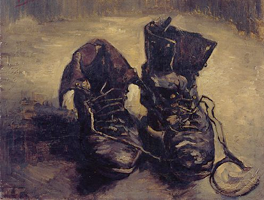
“The worker becomes all the poorer the more wealth he produces .... labor produces not only commodities: it produces itself and the worker as a commodity …”
--Karl Marx, The Economic and Philosophic Manuscripts of 1844, 107/71.
image: Van Gogh, A Pair of Shoes, 1886.
Tuesday, March 4, 2008


Karl Marx’s “Estranged Labor”